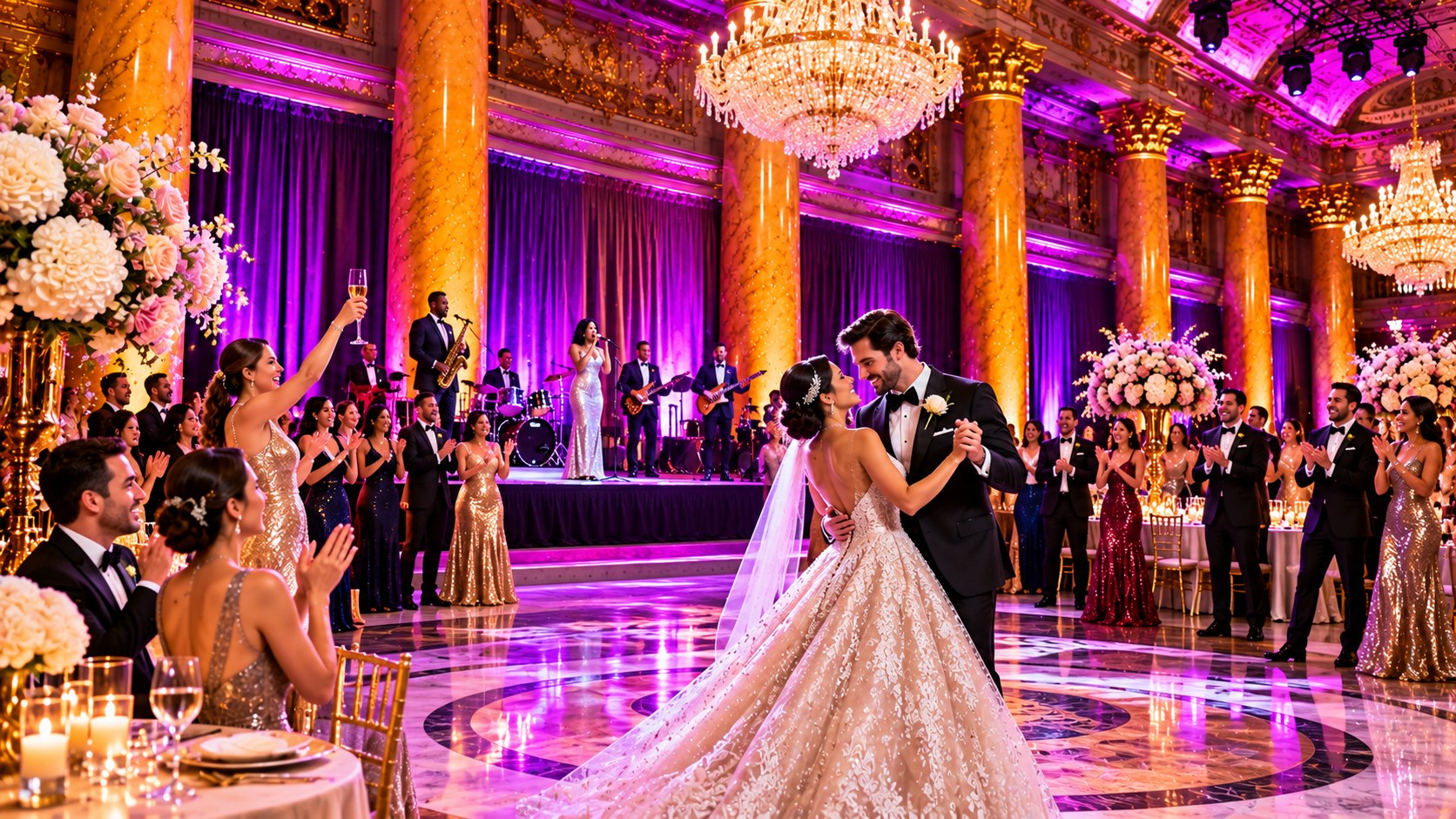
Production is the layer of a luxury wedding that guests feel more than see. The sound that carries the band, the lighting that shapes the room, the staging that frames the program, the video that captures the moment — these are the elements that elevate a celebration from beautiful to spectacular.
This guide walks through high-end wedding production for a New York City celebration, covering audio, visual, lighting, and staging, and how to plan and coordinate production so it enhances rather than overwhelms the celebration.
Why High-End Wedding Production Guide Matters for a Luxury NYC Wedding
High-End Wedding Production Guide is not a box to check — it is the framework that keeps a complex celebration on course. For a luxury wedding in New York City, where the number of moving parts is greater and the margin for error smaller, getting this right is the difference between a day that feels effortless and one that feels managed. This guide breaks high-end wedding production guide into the decisions and sequences that matter most.
What this guide covers
Every luxury wedding is a project with many dependencies — venue, vendors, guests, timeline, budget — and high-end wedding production guide is the discipline that holds them together. The couples who plan the most beautiful, least stressful weddings are not the ones with the largest budgets; they are the ones who approach high-end wedding production guide with clarity, sequence their decisions correctly, and build a team that executes.
The sections below walk through high-end wedding production guide in the order you will actually encounter it: what to prioritize, what to verify, how to sequence the work, how to budget for it, and how to coordinate the people who bring it to life. Use it as a working reference, not a one-time read.
A note on what this guide is not: it is not a guarantee of specific outcomes, prices, or availability. Luxury wedding costs and logistics in New York City vary enormously, and the right answer for one couple is wrong for another. What this guide offers is the framework to find your own right answer — the questions to ask, the sequence to follow, and the trade-offs to weigh.
- The decisions that define high-end wedding production guide and when to make them
- What to verify before committing to a vendor or a date
- A realistic sequence that keeps dependencies in order
- How to budget for this stage without surprises
- How to coordinate the team that executes on the day
The Core Decisions in High-End Wedding Production Guide
High-End Wedding Production Guide resolves around a handful of decisions that shape everything downstream. Making these decisions deliberately — and in the right order — prevents the cascading revisions that derail a timeline and inflate a budget. Treat each as a commitment that narrows your options productively rather than a hurdle to clear quickly.
Decisions to make first
Sequencing the decisions
The first decision in high-end wedding production guide is always scope: how many guests, what level of formality, and what overall vision. These three facts eliminate most options immediately and focus the remaining work. Couples who skip this step end up evaluating venues, vendors, and menus that cannot coexist, then revising everything when the scope finally clarifies.
The second decision is budget — not the final number, but the order of magnitude and the priorities within it. A budget that reflects your priorities gives every later decision a frame; a budget built after the decisions are made is just an accounting of what you spent.
The third decision is team: who will help you execute. A planner, a venue coordinator, and a set of vendors who work well together are worth more than any single beautiful element. The team you build determines whether your decisions hold up on the day or unravel under pressure. Choose people whose work you respect and whose communication you trust.
- Define scope — guest count, formality, and vision — before anything else
- Set a budget order of magnitude and rank your priorities within it
- Reserve the venue before booking vendors so vendors design to the space
- Book long-lead vendors (photo, video, florist, caterer) before short-lead ones
- Finalize the guest count before the seating plan so the plan fits the room
What to Verify Before You Commit
In high-end wedding production guide, the details you confirm before signing determine whether the day delivers what you expect. A vendor or venue that looks ideal on paper can have hidden constraints — capacity limits, exclusivity caveats, cost surprises, or logistical restrictions — that only emerge in the contract or on the day. Verification is not pessimism; it is professionalism.
Verification checklist
The most common source of disappointment in luxury weddings is not a single big mistake but a series of small assumptions that turned out to be wrong — the assumption that exclusivity meant full buyout, that the service charge was included, that the vendor would handle the turnover. Each assumption is cheap to verify and expensive to discover too late.
Get every material term in writing, not in a conversation. A verbal assurance about exclusivity, capacity, or inclusions is worth exactly nothing if it is not in the contract, and the contract is the document that governs when expectations diverge. If a vendor or venue will not put a term in writing, treat that as the answer.
Verify the experience, not just the portfolio. A vendor's portfolio shows their best work; what you need to know is whether they can produce that work consistently at your scale and format. Ask how many events at your guest count they execute per year, ask for references from couples with similar events, and ask what goes wrong when things go wrong — the answer reveals more than any photograph.
- Confirm capacity for your specific format, not the venue's maximum
- Verify what exclusivity actually means and get it in the contract
- Request the complete cost picture — site fee, minimums, service charge, taxes, required rentals
- Confirm the vendor's experience at your scale, not just their portfolio
- Check load-in logistics, power, and any restrictions on decor or production
- Read cancellation, weather, and force-majeure clauses before signing
Building a Realistic Timeline
A realistic timeline is the backbone of high-end wedding production guide. It coordinates vendors, sequences the celebration, and ensures every moment happens when it should. A well-built timeline makes the day feel effortless; a poorly built one creates stress, awkward gaps, and rushed moments that guests feel even if they cannot name them.
Timeline principles
The best timelines build in buffer, not slack. Buffer is planned time that absorbs the inevitable small delays — a late vendor, a longer ceremony, a service rush — without pushing the whole evening back. A timeline with no buffer is a timeline that will break; a timeline with generous buffer is one that holds its shape under pressure.
Sequence the day around the guest experience, not the vendor convenience. Guests should never wait for the room to turn, never wonder what happens next, and never feel rushed through a moment that should breathe. The timeline serves the celebration, not the logistics.
Share the timeline with every vendor and confirm they can meet it. A timeline that works on paper but conflicts with a vendor's load-in window or service capacity is a timeline that will slip. The final timeline is a negotiated document — built with the people who have to execute it, not handed to them after the fact.
- Build buffer into every transition — assume things run ten minutes late
- Sequence the day around the guest experience, not vendor convenience
- Give the ceremony room to breathe — unhurried reads as elegant
- Plan the turnover so guests never wait for the room to turn
- Pace the dinner so courses land without rushing or lagging
- Build the dancing hours around energy peaks, not a fixed clock
Wedding Planning Timeline Builder
Click each phase to reveal the key tasks for that stage.
- ◆ Set budget
- ◆ Reserve venue
- ◆ Book planner
- ◆ Draft guest list
Budgeting for This Stage
High-End Wedding Production Guide has its own cost profile, and understanding it prevents the surprises that derail a budget. Some elements are fixed early — the venue, the major vendors — while others emerge as decisions accumulate. Budget actively throughout, not once at the start, and rebalance when priorities shift.
How to allocate and track
Track every commitment against the budget in real time, not at the end. A spreadsheet or planning tool updated as decisions are made surfaces trade-offs while there is still time to make them; a budget reviewed after the deposits are paid is just a record of what already happened. The discipline of tracking is what keeps a luxury budget intentional rather than reactive.
- Allocate by priority — spend more on what guests experience directly
- Track every commitment against the budget in real time
- Rebalance when a decision in one category affects another
- Hold a contingency reserve for the inevitable additions
- Compare vendors on total cost, not the headline quote
- Review the budget at every major milestone, not just at the end
Coordinating the Team
A luxury wedding is the work of a team, and high-end wedding production guide is the discipline that makes them work together. Each vendor is a professional in their craft, but the celebration comes together only if they are coordinated. That coordination is either your job, your planner's job, or a gap that shows on the day.
Coordination essentials
The single most valuable coordination tool is a shared timeline that every vendor receives and agrees to. When the florist, the caterer, the lighting designer, and the venue all work from the same document, the day has a spine. When each works from their own version, the gaps between those versions become the awkward moments guests notice.
- Distribute one shared timeline to every vendor and confirm they agree to it
- Assign a single point of contact for the day so vendors are not pulled in two directions
- Confirm load-in and load-out windows for each vendor to prevent conflicts
- Hold a final walkthrough with the venue and key vendors two to four weeks out
- Build a day-of contact sheet with every vendor's name, role, and phone number
Common Pitfalls and How to Avoid Them
Most problems in high-end wedding production guide fall into a small number of recurring patterns. Recognizing them in advance is cheaper than learning them on the day. The pitfalls below are the ones that surface most often in luxury NYC weddings, and each has a straightforward prevention.
Pitfalls to watch for
The most common pitfall is booking out of sequence — a vendor before the venue, a menu before the guest count, a seating plan before the final headcount. Each out-of-order decision creates a revision later, and revisions are where budget and timeline leak. Follow the sequence even when it feels slow; the discipline pays off.
- Booking vendors before the venue is confirmed — design to the space, not around it
- Assuming exclusivity means full buyout without verifying in the contract
- Underestimating the turnover time and leaving guests in an awkward gap
- Skipping the final vendor walkthrough and discovering conflicts on the day
- Building a timeline with no buffer so one delay cascades through the evening
- Comparing vendors on headline price rather than total cost of the evening
Related Planning Guides
Frequently Asked Questions
These common questions address the details couples ask most when researching high-end wedding production guide in New York City.
What should I look for when researching high-end wedding production guide in New York City?+
Focus on capacity for your guest count, architectural character, service standards, and the venue's experience with events at your scale. Tour a few representative options, use a consistent checklist at every visit, and request proposals from your shortlist before deciding.
How far in advance should I book high-end wedding production guide in NYC?+
The most sought-after luxury settings in New York City book twelve to eighteen months ahead. Peak season (May through October) and popular weekends fill first, so begin research early and move quickly once you find the right fit.
What is the capacity I should plan for with high-end wedding production guide?+
Capacities vary by format. Our featured setting accommodates 550 seated guests or up to 1,500 standing. Always confirm seated versus standing capacity for your specific format, since the guest experience differs significantly between a plated dinner and a standing reception.
Do high-end wedding production guide host both ceremony and reception?+
Many do. Ask how the venue manages the transition between ceremony and reception, whether there is a separate cocktail area, and how long the turnover takes. A well-managed transition is invisible to guests; a poorly managed one creates awkward downtime.
What questions should I ask when touring high-end wedding production guide?+
Ask about capacity for your format, included amenities, service staff ratios, catering policy, production infrastructure, exclusivity terms, and the full cost including service charge and taxes. Our questions-to-ask guide provides a complete checklist.
How much do high-end wedding production guide in NYC typically cost?+
Costs vary widely based on scale, exclusivity, and what is included. Compare venues on the total cost of the evening — site fee, catering minimums, service charges, rentals, and production — rather than the headline site fee alone.
Are high-end wedding production guide available year-round in New York City?+
Most indoor luxury venues operate year-round. Rooftop and outdoor settings are typically seasonal (roughly May through October). Confirm availability for your date and any seasonal considerations. A winter indoor celebration offers reliable comfort and often better availability.
Can I fully customize the decor at high-end wedding production guide?+
Most luxury venues allow significant customization within their guidelines. Ask about rigging points, electrical capacity, restrictions on candles or installations, and load-in logistics. Venues with strong event infrastructure support more ambitious design.
Do high-end wedding production guide include in-house catering?+
Some venues include in-house catering; others allow outside caterers or require selection from a preferred list. Confirm the catering policy and how it affects your menu options and overall budget.
What is the difference between seated and standing capacity at high-end wedding production guide?+
Seated capacity accommodates a plated dinner with tables; standing capacity accommodates a cocktail reception. A venue that seats 550 may hold far more standing, but the flow, comfort, and pacing differ. Choose based on your preferred format.
How do I ensure guest comfort at high-end wedding production guide?+
Plan for smooth arrival, coat check, comfortable temperature, sufficient restrooms, attentive service, clear signage, and accessible seating for those who need it. Walk through the guest experience from arrival to farewell and address any friction with your venue team.
Do high-end wedding production guide offer exclusivity?+
Exclusivity varies by venue — full buyout, single-event, or shared common areas. Confirm exactly what exclusivity means at each venue and have it specified in your contract. See our wedding venue exclusivity guide for detail.
Which NYC neighborhoods are best for high-end wedding production guide?+
Manhattan offers the highest density of luxury venues. Midtown is known for grand ballrooms, the Upper East Side for classic elegance, and Downtown (Tribeca, SoHo) for loft settings. Explore our NYC area guides for neighborhood-specific planning considerations.
Can high-end wedding production guide accommodate dietary restrictions?+
A quality luxury venue accommodates vegetarian, vegan, kosher, halal, and allergy-specific needs. Discuss dietary requirements early and ensure every guest has a considered option, not an afterthought.
What is the service charge at high-end wedding production guide?+
Service charges typically range from 20% to 28% on top of food and beverage, plus applicable tax. Confirm the full cost structure — site fee, catering minimums, service charge, gratuity, and taxes — when comparing venues.
Do high-end wedding production guide provide a wedding coordinator?+
Many luxury venues provide a venue coordinator for logistics, but that role is distinct from a full wedding planner. A venue coordinator manages the venue side; a planner manages your entire event. Consider whether you need both.
How should I tour high-end wedding production guide in NYC?+
Schedule tours, ideally when the space is set for an event so you can see it in action. Bring a consistent checklist, take photos, and note your impressions immediately after each visit while details are fresh.
What is typically included in the venue fee for high-end wedding production guide?+
Inclusions vary. Some venue fees cover only the space; others include tables, chairs, basic lighting, and a coordinator. Clarify exactly what is included and what you must rent or bring in separately so you can compare total costs.
Can high-end wedding production guide accommodate a large guest list?+
Yes, many luxury NYC venues accommodate large guest lists. Our featured venue seats 550 and holds up to 1,500 standing. Confirm capacity for your format and ask how the venue manages logistics at scale.
How do I begin planning my wedding with high-end wedding production guide?+
Start by clarifying your vision and guest count, then research venues that fit. Tour representative options, request proposals, and ask thorough questions. When ready, submit an inquiry through our form to receive personalized guidance.